Reliability vs Latency
Quantify the trade-off between packet length and error rate.
How the workflow runs
Import the city geometry into AEDT — here, downtown Los Angeles from OpenStreetMap. Both terminals carry a single Hertzian-dipole antenna.
Configure one terminal as transmitter and one as receiver, with a 5 GHz center frequency and 100 MHz of channel bandwidth.
Assign transmit power (1 W per subcarrier) and noise power (−90 dBm). Compute SNR per subcarrier with perfect and estimated CSI, then evaluate the asymptotic finite-blocklength bound on block error probability to find the target packet length.
Results
SNR under imperfect channel knowledge and the finite-blocklength error bound together set the achievable reliability for a given latency.
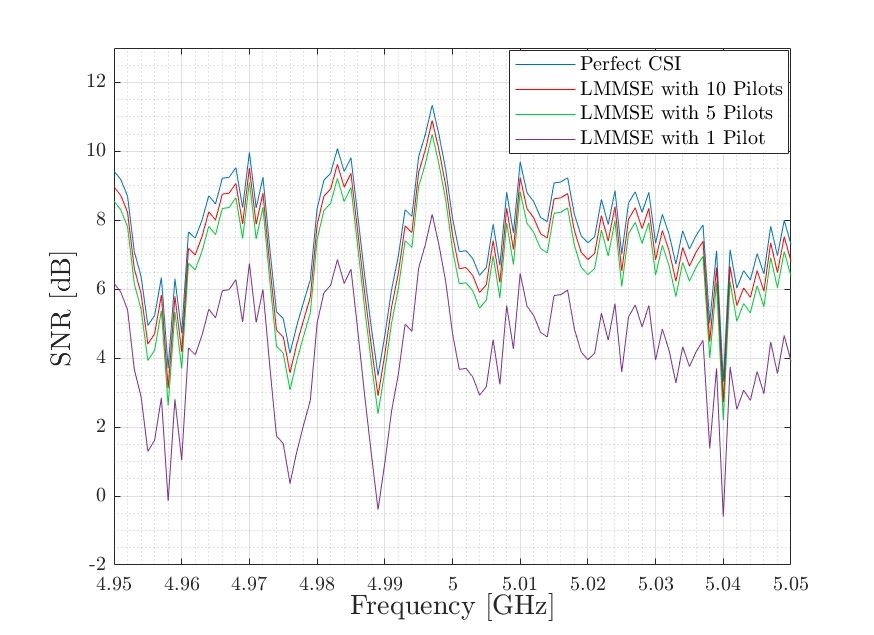
SNR is plotted versus frequency with perfect CSI and with a scalar LMMSE estimate from pilot symbols, the channel error treated as added noise. With a single pilot the SNR is well below the perfect-CSI case; as pilots increase it quickly converges.
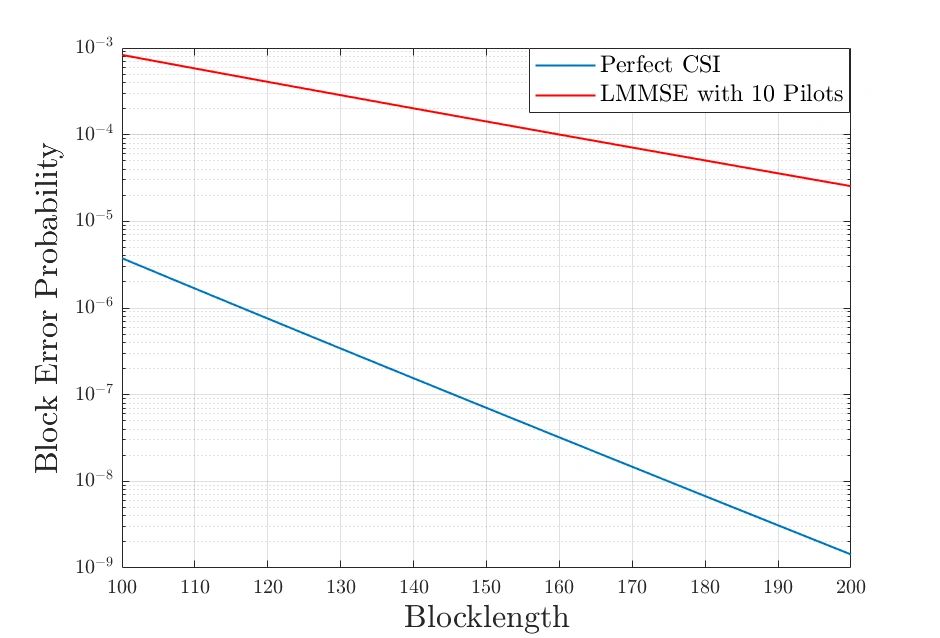
Using the Polyanskiy finite-blocklength limit at 5 GHz, block error probability is plotted against blocklength from 100 to 200 bits — for perfect CSI and for a 10-pilot LMMSE estimate. With channel error, a noticeably longer code is needed to reach the same error probability.
Run this workflow on your geometry
WirelessAI agents set up and run this study on top of your Ansys Electronics Desktop environment — no Python required.